
What the Noken Carries
By Mahenaw Wara
Source : Medium.com@Mahenaw
Part 1: Coffee, hornbills, and asking the river for permission
Sixteen years after a classroom in Canberra, I finally walked into the forests of Papua. I went to observe. I came home carrying something I hadn’t packed.
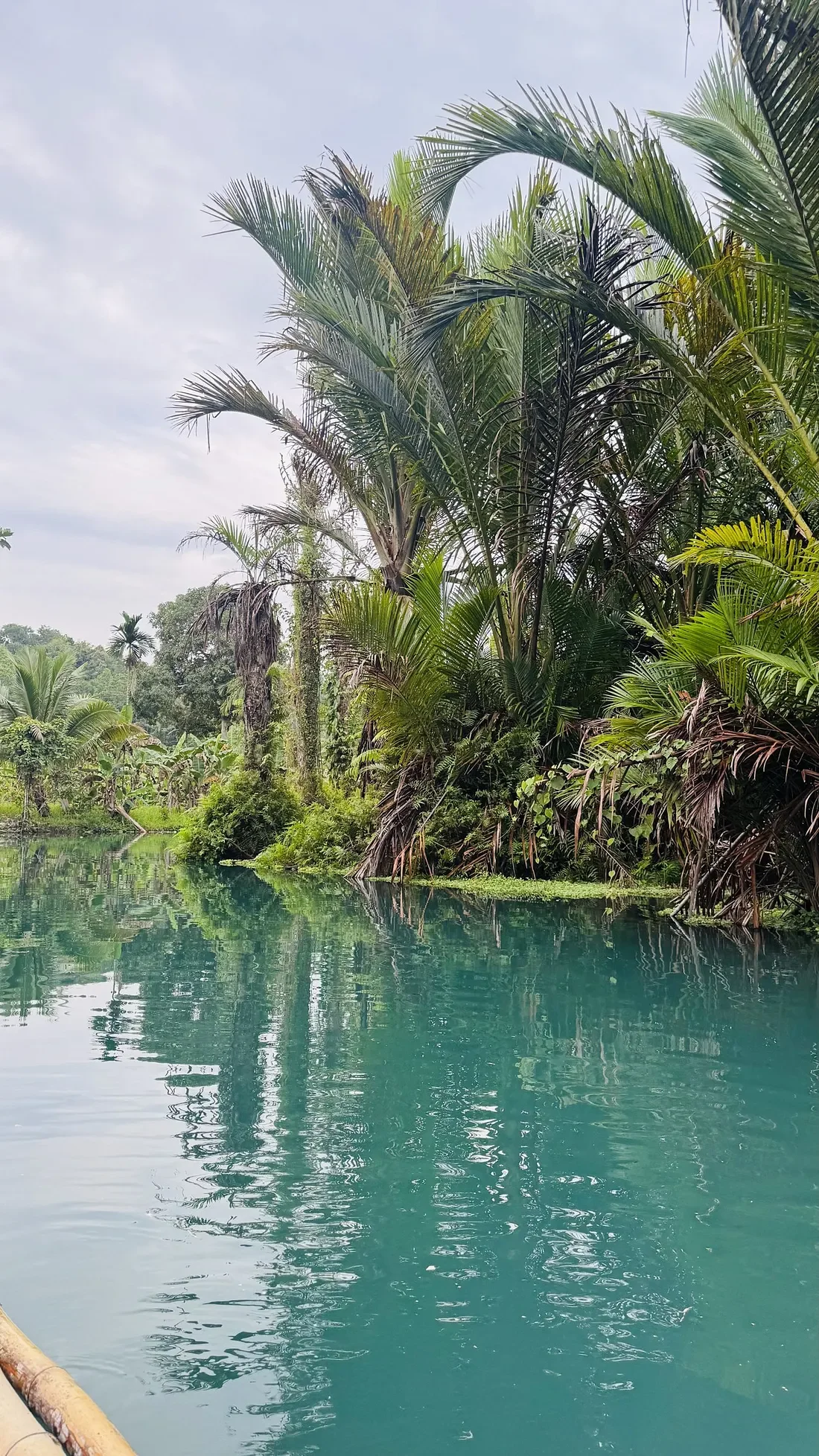
Some rivers don’t need a filter. This one doesn’t even need a caption.
A wish from a classroom
In 2010, I was a master’s student at the Australian National University, and Papua New Guinea kept appearing in my reading lists. Mines. The politics of mines. Violence between communities, and between communities and corporations. Governments that looked the other way. Friends went hiking there; some took jobs at mining companies; some went birdwatching. I was a student with very little money and one very large wish: one day!
The other Papua, the Indonesian side of the island, came to me through people. My classes were full of warm, fun-loving Indonesian classmates. Many of them were on scholarships; some were government officials. In our classroom debates about forests, communities and conservation, about what a tree is “worth,” I sometimes sensed a quiet undercurrent running between the Papuan students and the others. I could never put my finger on it. I still can’t. But I never forgot how I felt.
Sixteen years later, the wish came true. The first thing to arrive in my email was a list of malaria precautions and undertaking forms. Dreams, it turns out, come with a packing list.
Arriving as a zombie
Getting there took two back-to-back overnight international flights, Dhaka to Singapore and Singapore to Jakarta, a day at a friend’s place not quite sleeping or resting, and then a half-past-midnight flight to six hours east. By the time we landed in Sentani, I was less a person than a pair of eyes looking for hot water. I travel with ground coffee and my little espresso maker. All I needed was hot water, and I had one question in my head: when?
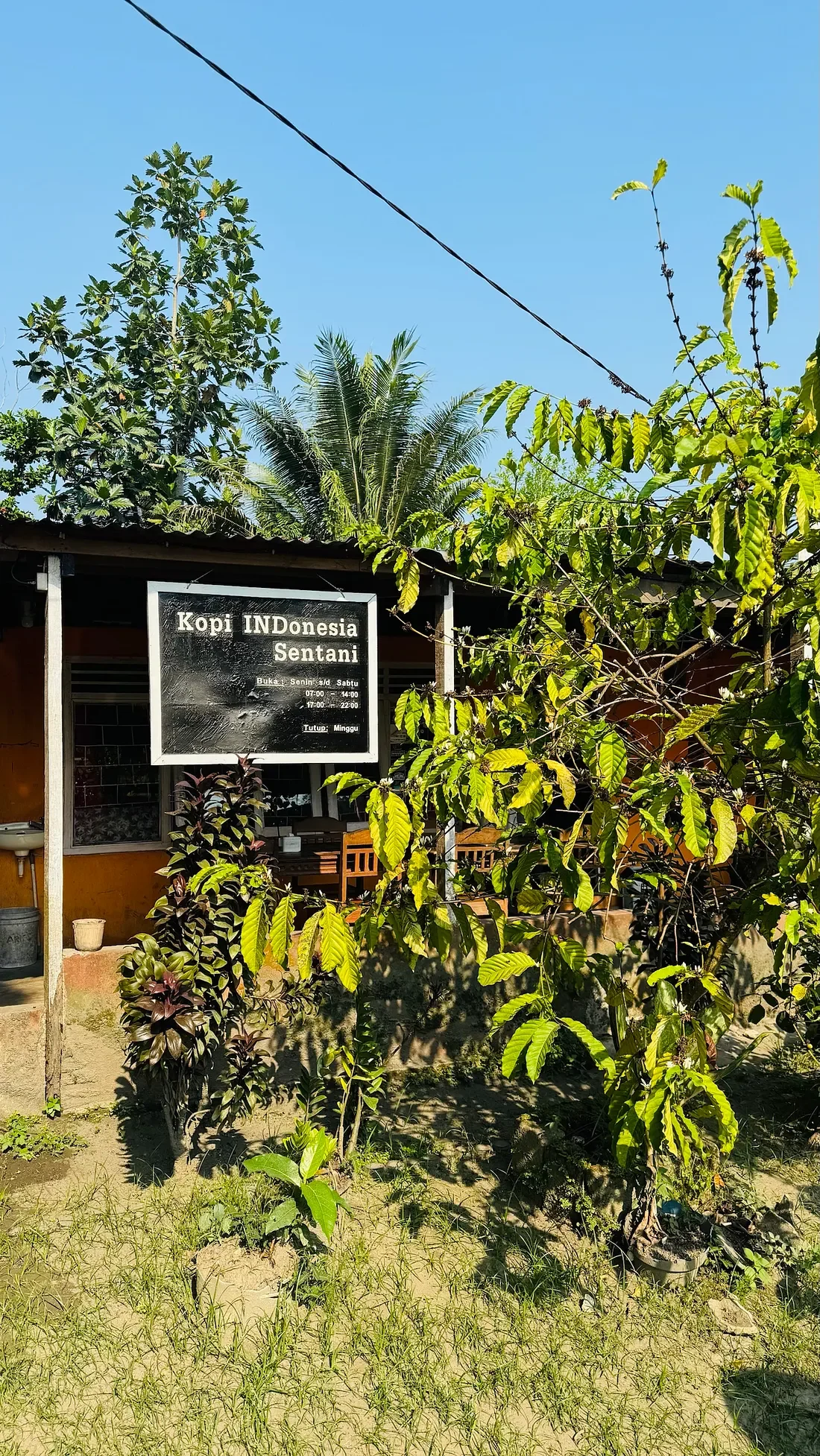
When the coffee grows outside the door, you know you’re in the right place.
Ruwi, co-founder of Mitra BUMMA, the organisation hosting us, answered before I could ask. He drove us to Kopi INDonesia Sentani, a tiny roastery with a garden, a breakfast cooked by the owners themselves, and a ginger dog who studied our plates with great professional interest.
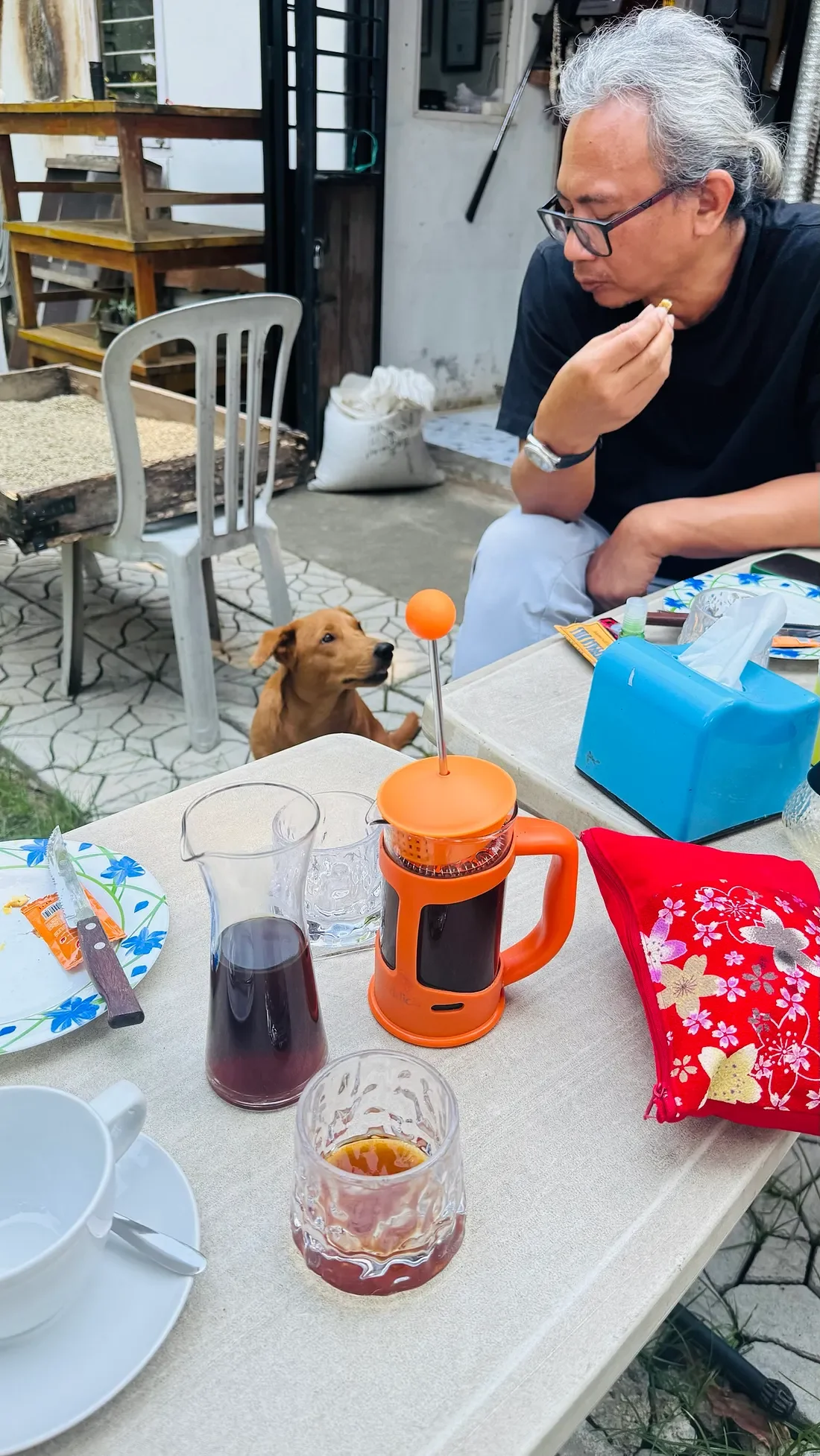
Our breakfast inspector. Nothing got past him.
Farmers and home growers from across Papua bring their beans straight here to be roasted. But what undid me was the packaging. Every bag names the grower, the roaster, and the climate the beans grew in. In a land where outsiders have so often taken without asking whose it was, here was a small business that insisted on naming the hands.
I decided on the spot that on my last day I would fill my carry-on with as much of this coffee as it could hold. I did. I still drink it almost every morning with a grateful heart.
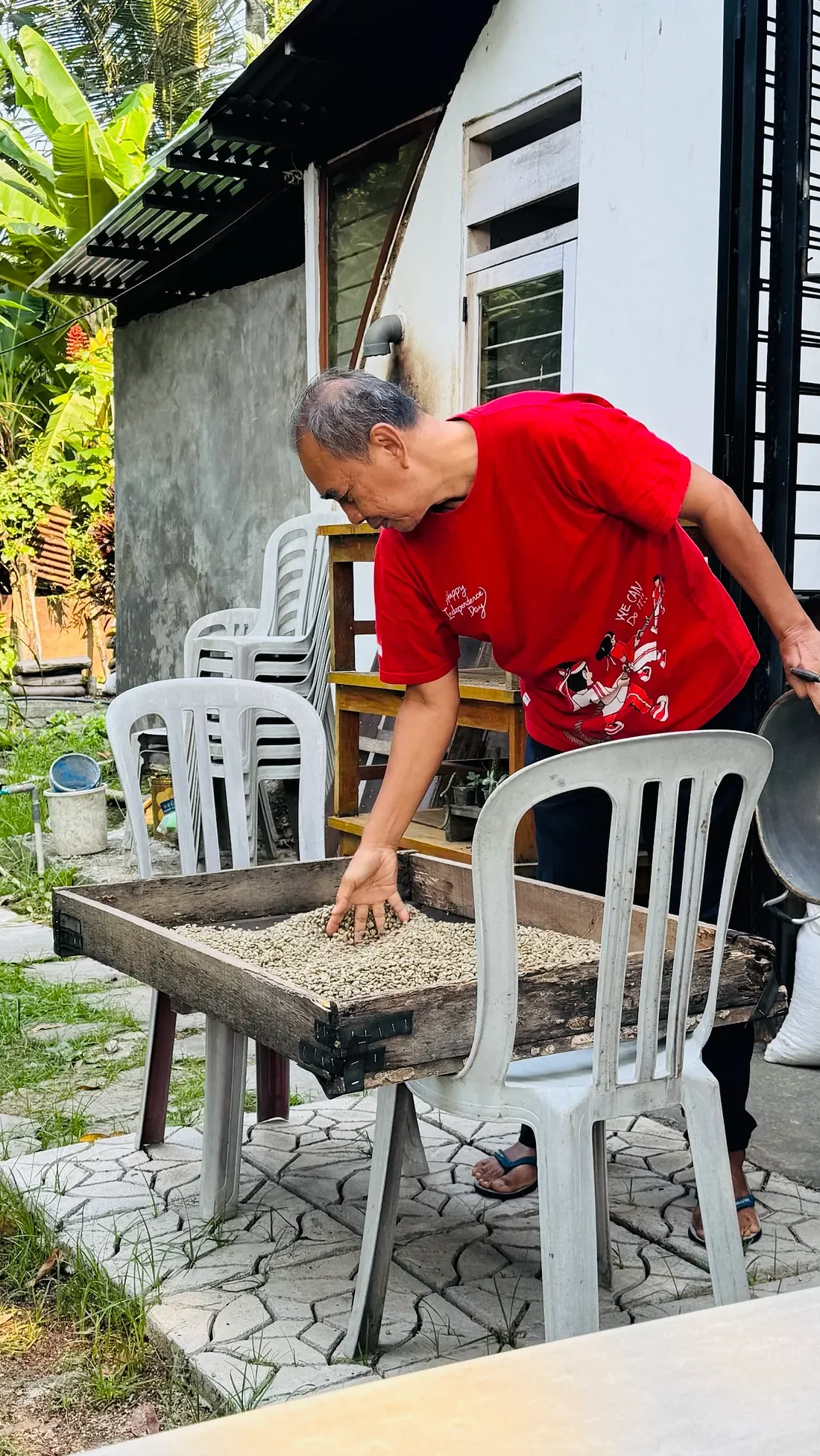
Before the cup, before the bag, there are always hands.
“Girl, you are living my dream”
Our first meeting was at the BUMMA Namblong office: a wooden floor, bamboo posts, a thatched roof, and a circle. Everyone introduced themselves: the Namblong team, the Mitra BUMMA team, and us. BUMMA Namblong is the Namblong people’s own enterprise, run by them. Mitra means partner, or friend, and Mitra BUMMA stands beside them as a friend, as a partner.
Then I met Yohana. Calm, soft-spoken, unhurried. Later I learned that the elders of forty-four clans had sat together and unanimously chosen her to lead BUMMA Namblong. Forty-four. Unanimously. I’ve seen families fail to agree on a restaurant.
“Girl,” I told her, “you are living my dream.”
Over the next days, I kept watching her. She doesn’t lead from the front, loudly, filling the room. She leads from the ground up, from the place, the land, and the people, and she weighs everyone before she decides. Where I come from, leadership is often inherited, like a surname. Here, it was handed to her around a circle until everyone agreed.
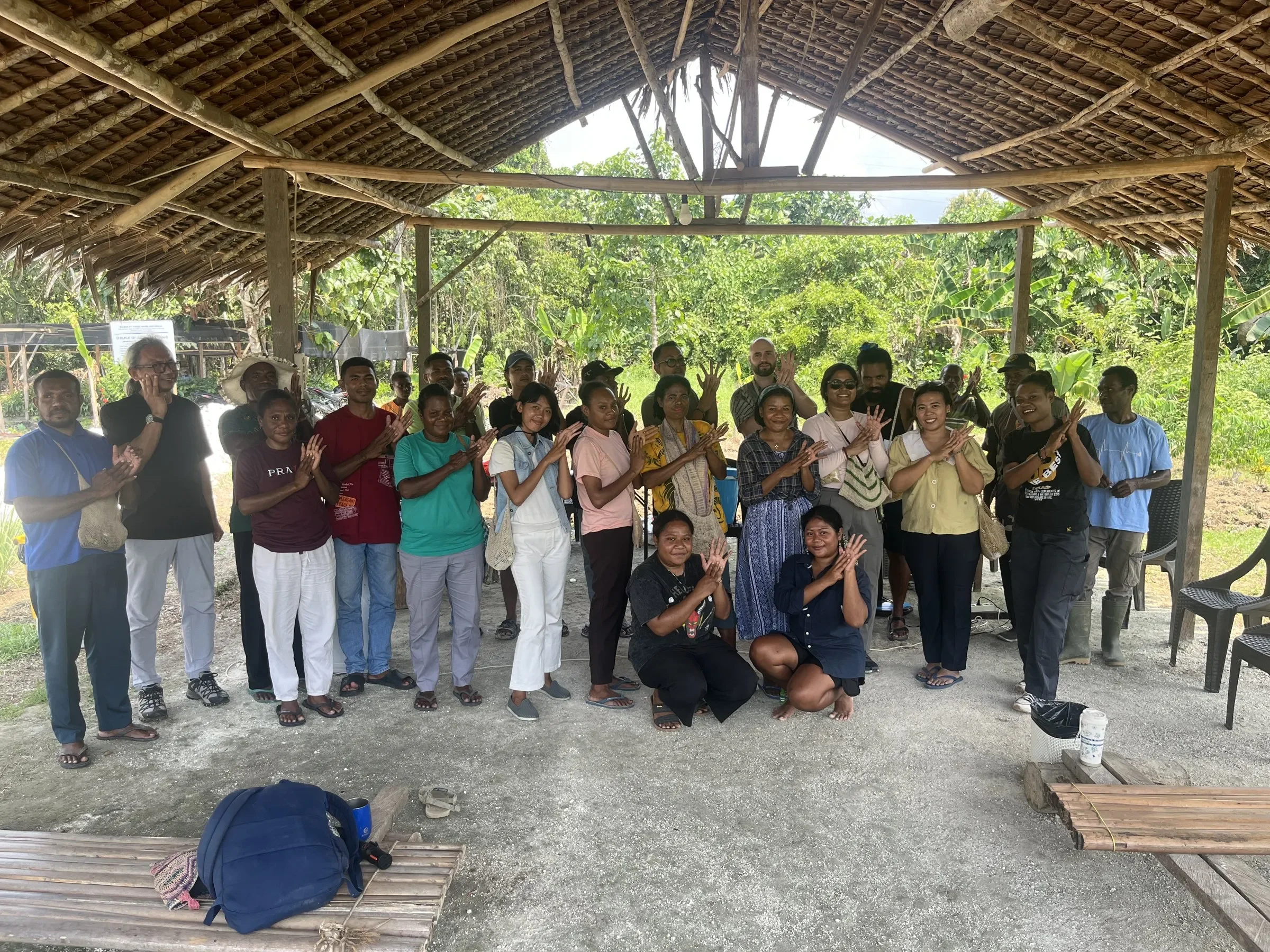
Forty-two clans, one circle, no head of the table.
That afternoon, we learned two words that stayed with me for the rest of the trip.
The first was noken. A noken is a woven bag, made from bark or palm fibre, worn across the body. But noken also means knowledge: something gathered patiently and given generously. The weave is open, so you can see what’s inside. Nothing is hidden. Knowledge, like kindness, is carried in the open. As we left, each of us was given a noken of our own. Mine is natural fibre, dyed green bits, and I loved it instantly. I still wear it with great pride.
The second word was menoken, dialogue. Long before Mitra BUMMA existed, its founders sat in menoken with the clans, around fires and in backyards, for as long as it took to agree on what should be done, how, and by whom. I told Ruwi we have the same thing in Bangladesh. We call it uthan boithok, the courtyard meeting. In villages without halls, every important conversation happens in someone’s yard. Different island, same yard.
The forest wakes up without us
That night we stayed at Isyo Hills, an ecotourism lodge in the forest, under a moon so bright it felt deliberate. Ruwi had apparently packed enough coffee for a small army. Every time we made eye contact, he asked, “Coffee?” Every time, I said yes. Absolutely grateful to him for it.
Over dinner the conversation turned to leeches. I looked down at my short socks and the strip of bare ankle between them and my trousers, and understood I was a buffet. The lodge saved me with a spare pair of rubber boots that fit perfectly.
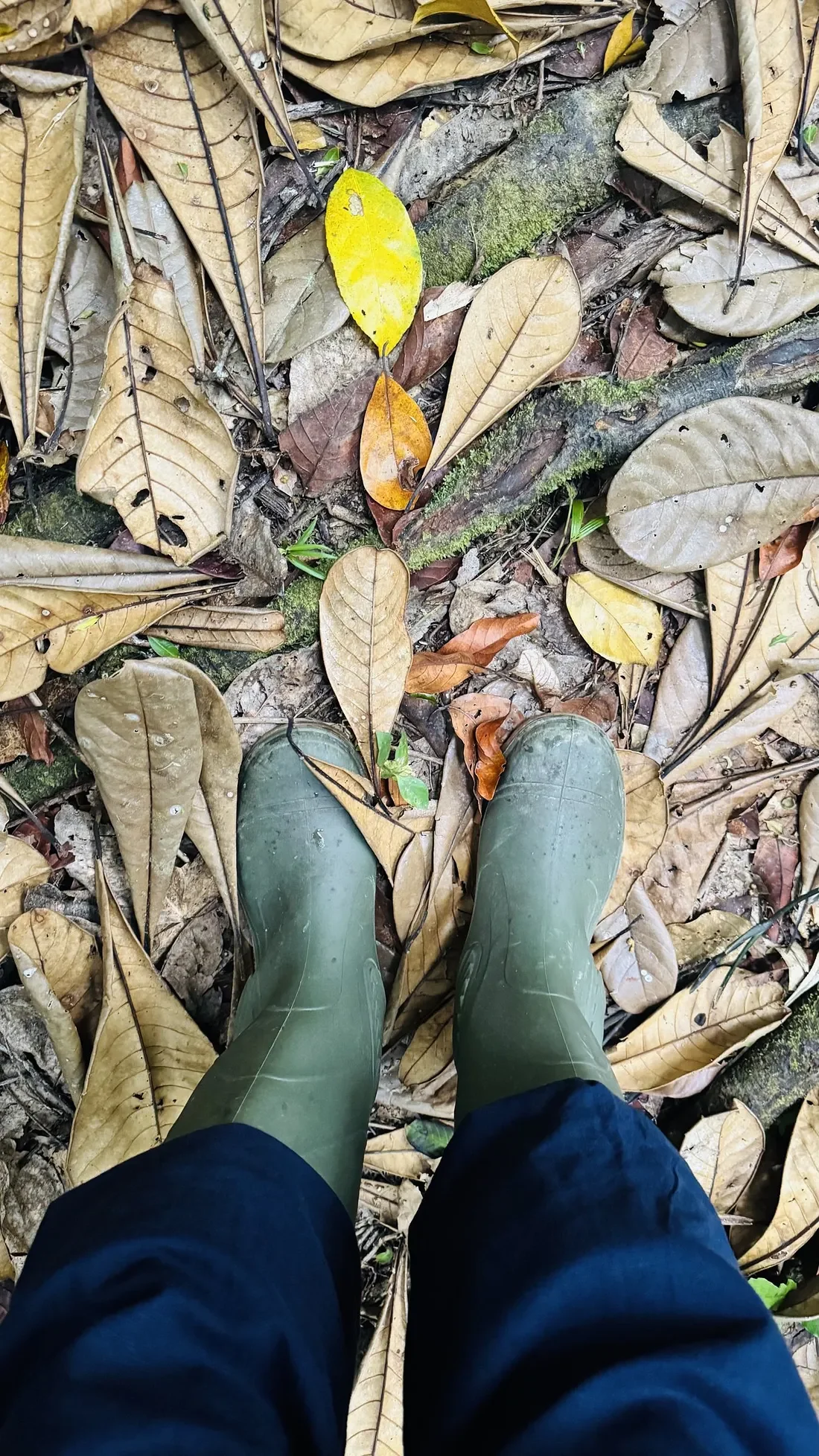
The most important fashion decision of my life.
At four in the morning, in the dark, our hosts served us cereal, eggs, and coffee. Papuan hospitality doesn’t check the clock. Then Papa Alex arrived to take us birdwatching.
I am not a morning person. I wake up early when I must, and I don’t enjoy it. But walking behind Papa Alex, I realised how many years of mornings I had slept through. The human world was asleep. Everything else was wide awake, and loud about it.
Papa Alex is less a birdwatcher than a magician. To birders he is something close to a legend; my colleague’s bird app kept citing him. He told us stories as we walked, folklore, forest prophecies, the habits of every bird. And then, in a clearing, we saw them: the birds of paradise, the cenderawasih, the males in full colour, dancing for the females at first light.
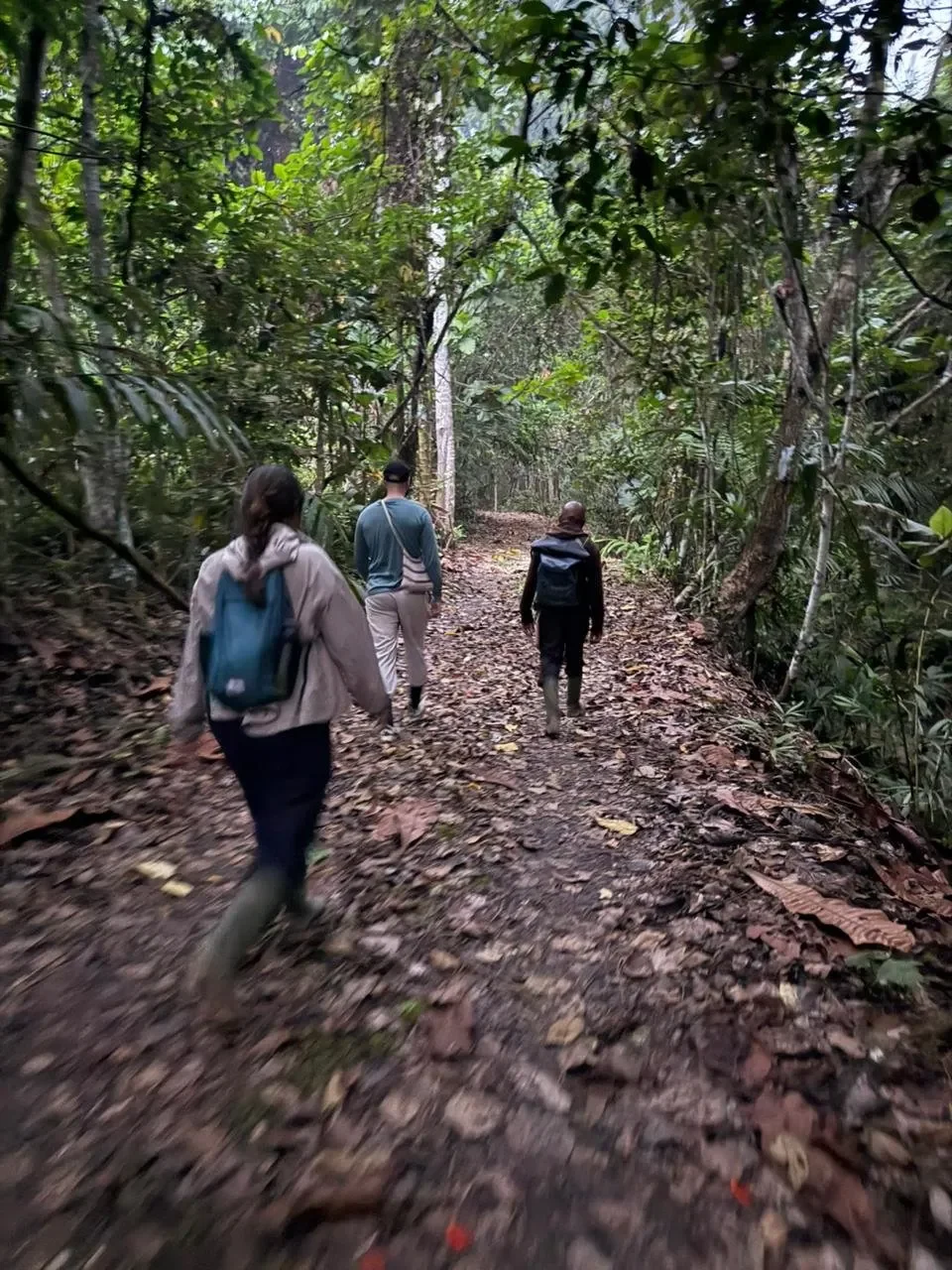
Follow the man who knows which bird is calling.
We climbed a little higher and sat down. Somewhere along the way, the four of us stopped talking. Not by agreement, we simply stopped. The sun was coming up, the breeze was cool, and no one was even looking at anyone else. In the deepest part of the forest, human words turned out not to be necessary.
And then a hornbill flew past us, at eye level, so close we could hear its wings beating the air.
That was it. That was the moment. I have tried to describe it to people since, and I keep mimicking the sound of those wings instead.
Asking permission
The rest of the day we visited the businesses that keep the forest standing: vanilla, ecotourism, forestry, and smaller ventures in fish and livestock. The Namblong team runs them and makes every decision. Mitra BUMMA helps with the parts forests were never designed for: the paperwork, the markets, the systems. From everything I saw, they never dictate, never lead, and never veto. They only support. Mitra: friend.
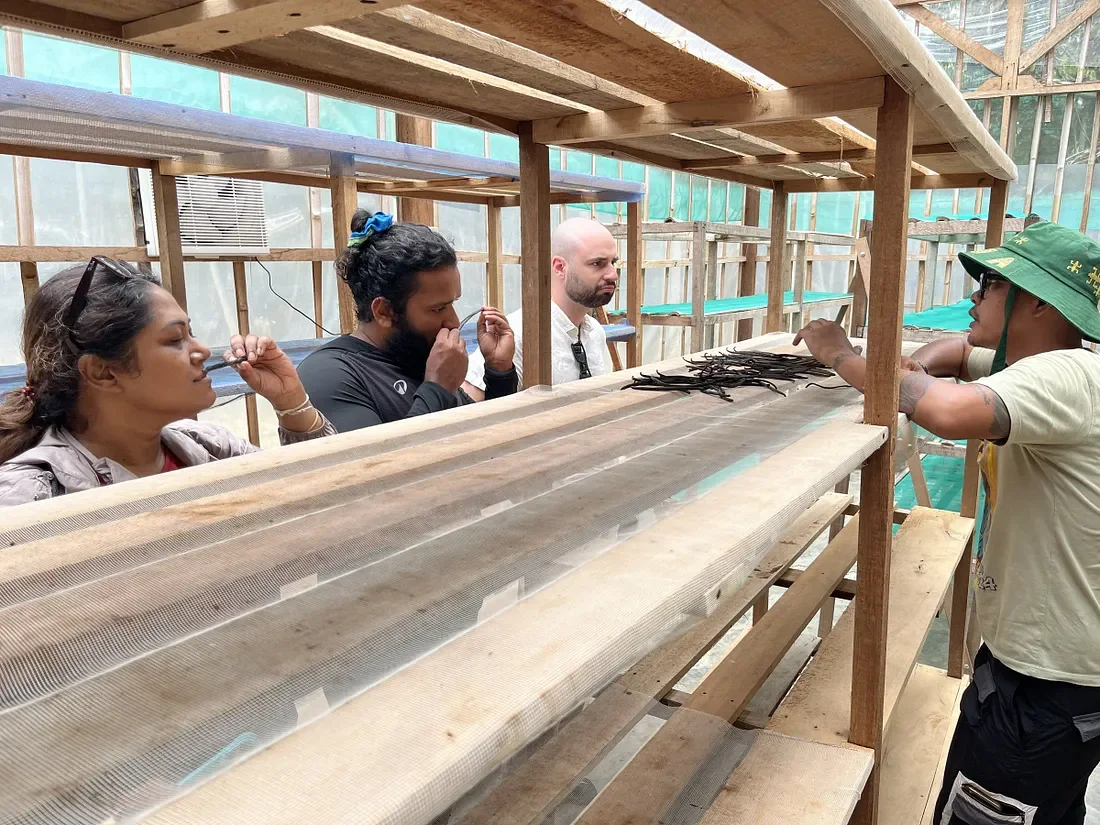
Yes, I sniffed the vanilla. Very professionally.
But the thing I can’t stop thinking about is smaller. Before entering a forest, before stepping into a river, before taking anything from either, the Namblong people stop. They ask permission. They say a short prayer, for the forest and for themselves, and only then do they go in.
In the cities most of us live in, we’ve forgotten we are part of nature at all. Here, that relationship is spoken aloud, every single day, before every single task. It isn’t a performance. It’s ingrained.
Who is encroaching on whom?
On the road to the river, the track grew so narrow that branches scraped both sides of our car. Our Namblong friends jumped out to hold the branches back while the rest of us sat inside worrying about scratches, the windows, and the car’s paint peeling off.
Sitting in the back seat, I had a different thought. The forest wasn’t encroaching on the road. We were encroaching on the forest.
That afternoon we passed land handed over to someone else’s plans, and I kept asking myself a question I still can’t answer: why should anyone have to guard their own home? Securing it means mapping it, marking every boundary, and waiting for a government to approve the map. While we were there, one clan received the news that their map had finally been approved. It had taken almost eight years.
Eight years, just for the map. I know friendships that didn’t survive eight months.
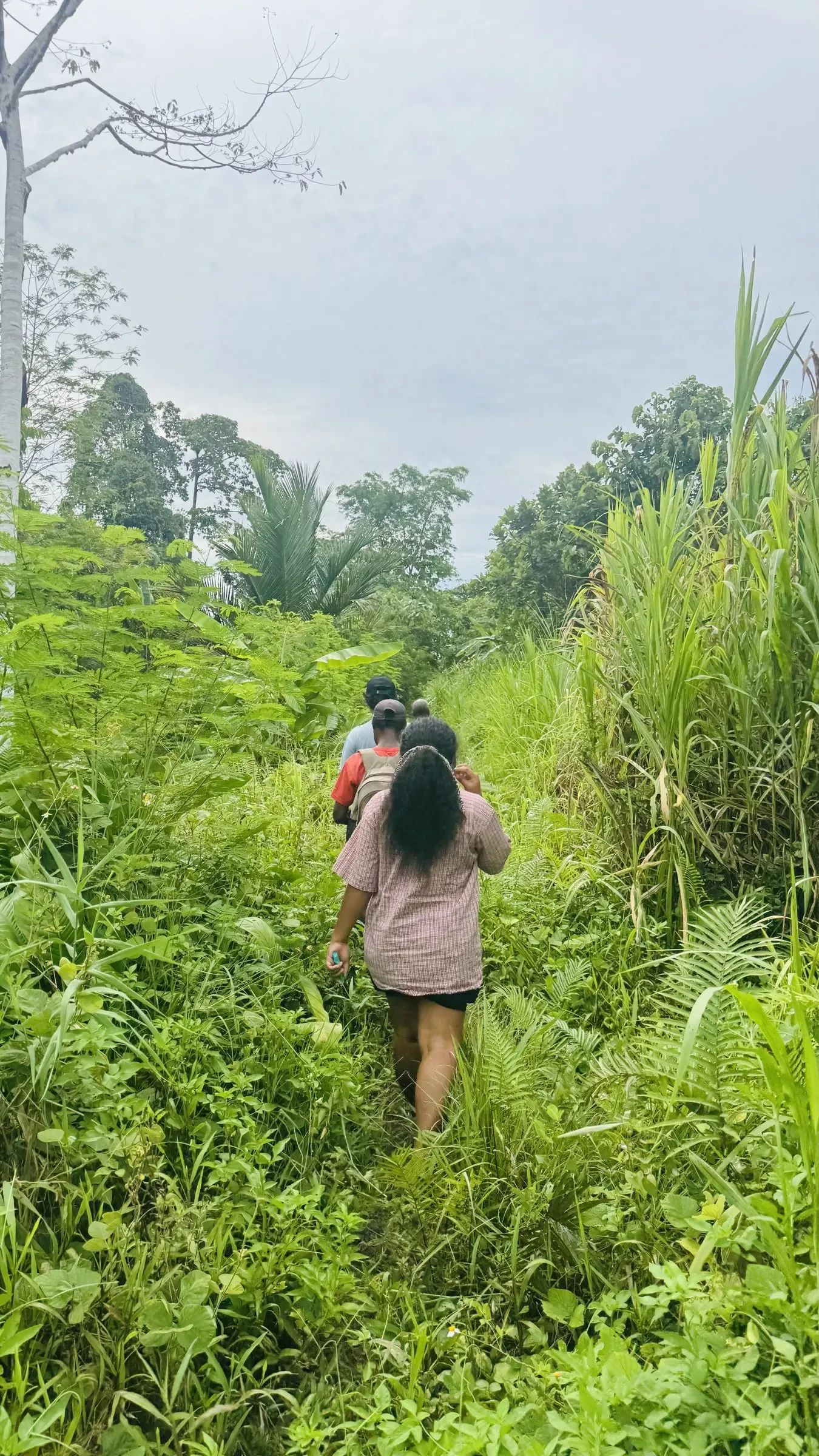
Here, the forest has right of passage for the people of the land!
The river, and the rain
At Nggam Bu, before stepping onto the bamboo raft, we did what the Namblong do. We touched the water, washed our hands and faces, and asked the river to carry us safely. Our guide was named Simon, which made two Simons on one raft and a great deal of confusion. He told us about every plant on the bank as the raft drifted through water so turquoise it looked lit from below. Varun took the oar. The sun went down.
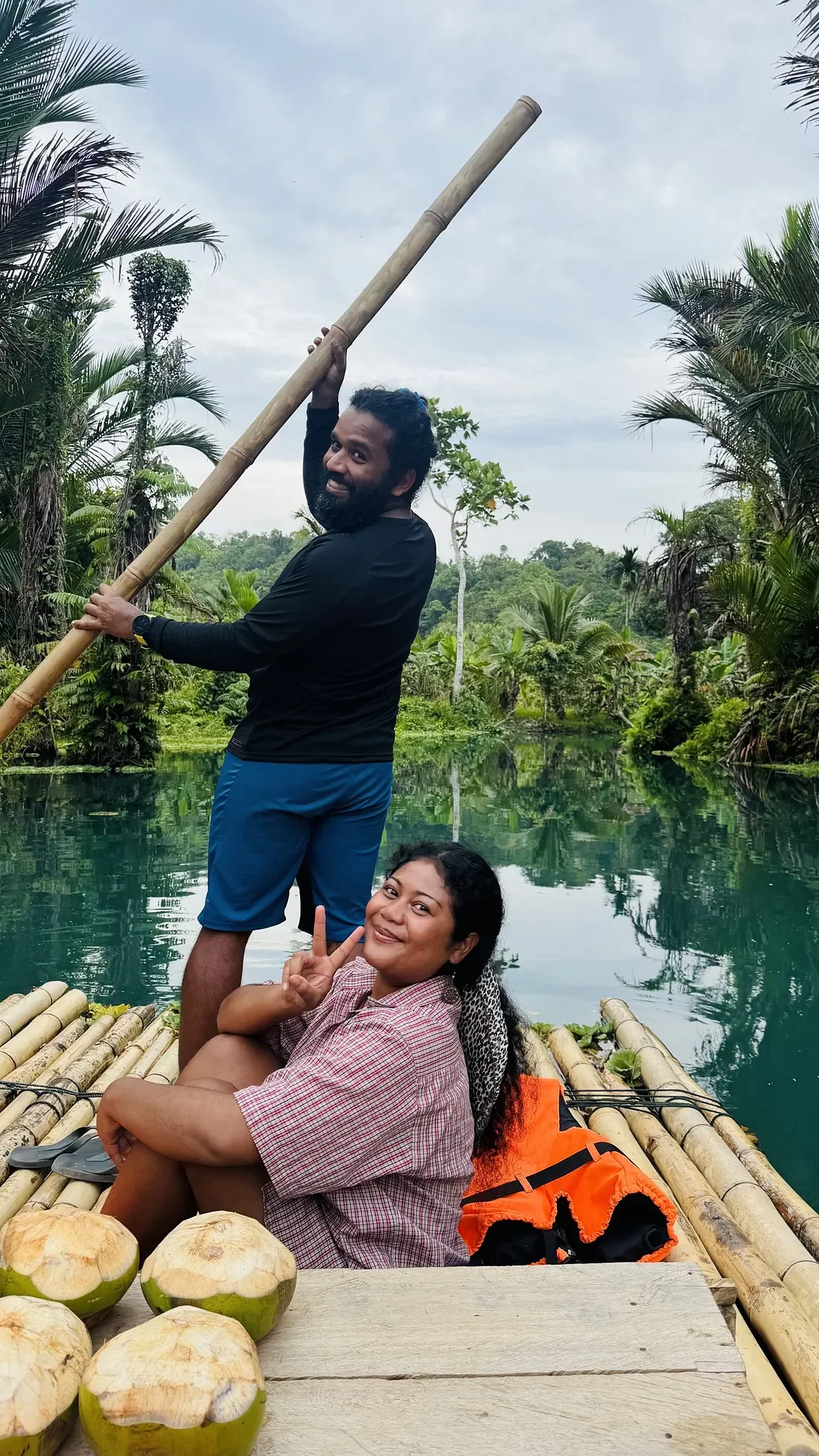
Two Simons chatting up about “living forest”, Varun on oar, Ranum has zero complaints.
This is Tanah Papua.
That evening we sat in menoken, reflecting on the day while dinner cooked. My colleague Simon bought betel nut from a local shop and tried it for the first time. His face said everything. Rudy, our cheerful friend whose mouth was never without betel, laughed harder than anyone.
We slept in tents on a scrap of land no bigger than a backyard, with the river running all around us. No electricity. No music. Just the river, the insects, and the forest breathing. At half past two, the rain began, gently and then not gently at all. When I crawled out at half past five, some of the tents had flooded. Mine, by some miracle, had not.
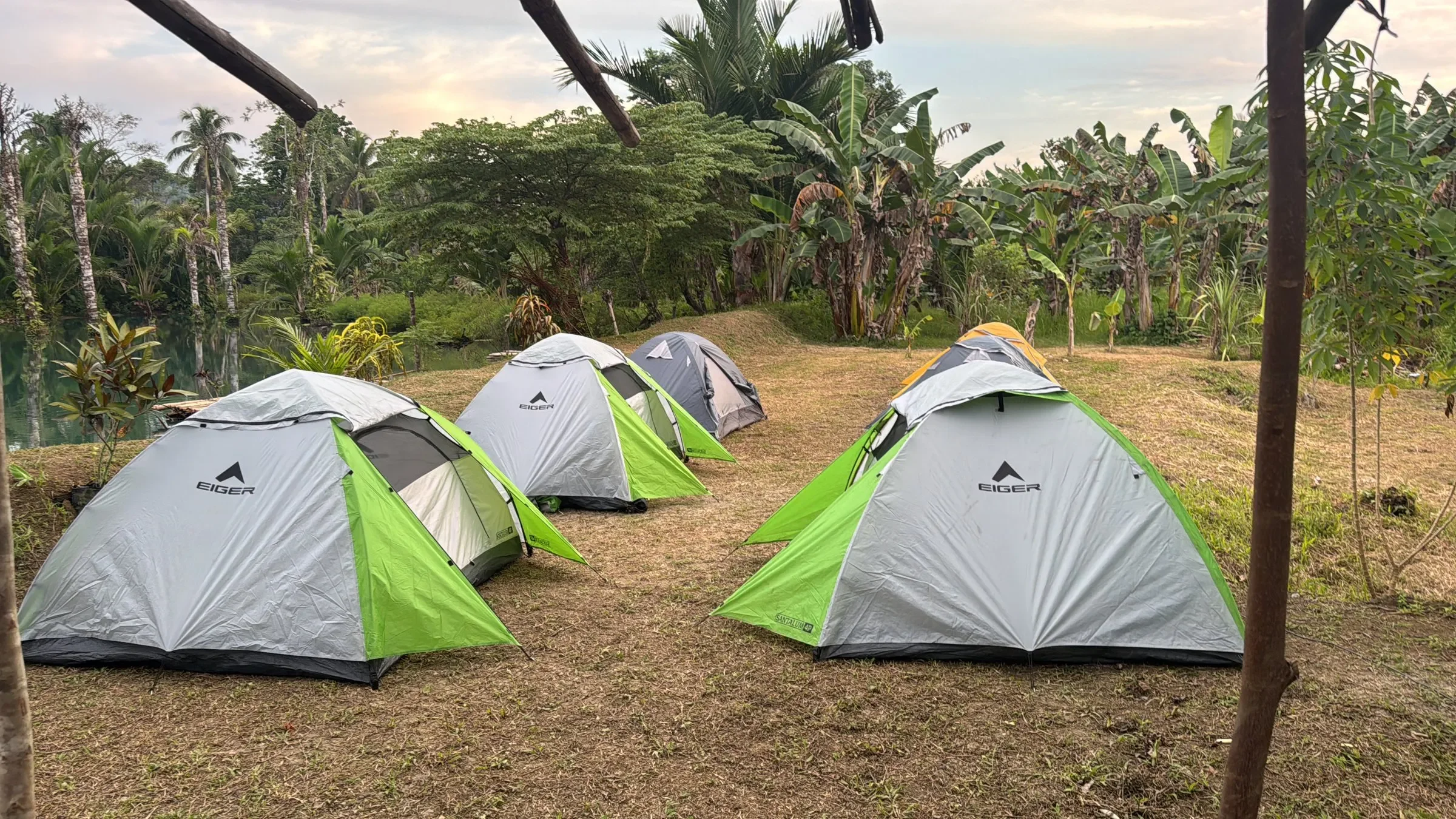
Location, location, location. (Some of us chose better than others.)
I won’t pretend it was easy. It sounds like camping, like a picnic, and there was laughter and wonderful food. But this is not a gentle place for a city person, and it is not a holiday for the people who live there. And still, if you let go, of the schedules, the rules, the idea that nature is something outside of you, it gives back something, which I can only describe as ‘nourishment’.
The morning briefing
The next morning, before I’d even had my first coffee (Ruwi’s, of course), Henry came over, beaming, to brief us on the day ahead.
Nggam Bu was the last place a car could reach. From here we would carry only a backpack each and walk deep into the forest, to a camp in Ktu Ku. Henry explained what to wear and what to expect. Then, with the same gentle smile he wore the whole time, he mentioned that statistically, one in three visitors catches malaria. There were three of us. He let us do the maths.
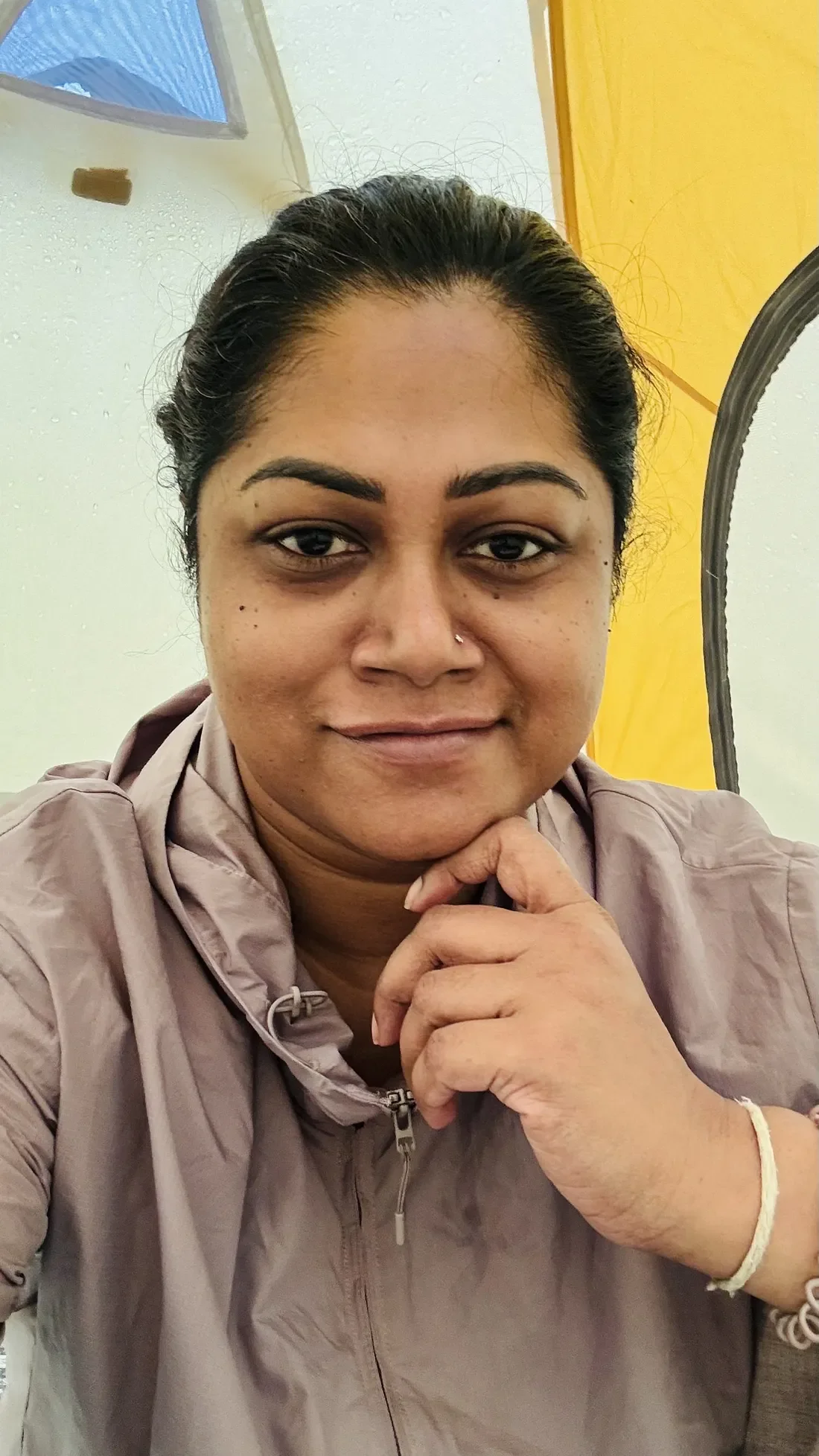
Me, at 05:30 feeling lucky because my tent wasn’t flooded before doing the maths.
Then he moved on to leeches. They would come from below, from above, from the sides, and through our many layers of clothes. There was nothing to be done about it. Not to worry, though: there was a way to flick them off. The only time to really worry, he added, was if one got into your eye. Then you couldn’t flick it out. You simply had to wait until it had drunk all the blood it could, and it would fall off on its own.
For ten or fifteen minutes he talked like this, never laughing, never not smiling. To this day I don’t know whether he was joking. My heart, I can tell you, stopped once or twice. Our Namblong friends had already given us long socks and knee-high rubber boots, so in theory we were prepared. In theory.
“From the moment we enter the forest,” Henry said, “until we come back here tomorrow, there will be leeches all around. Round and round.”
Then he smiled, picked up his bag, and we followed, obediently.
To be continued in Part 2.
